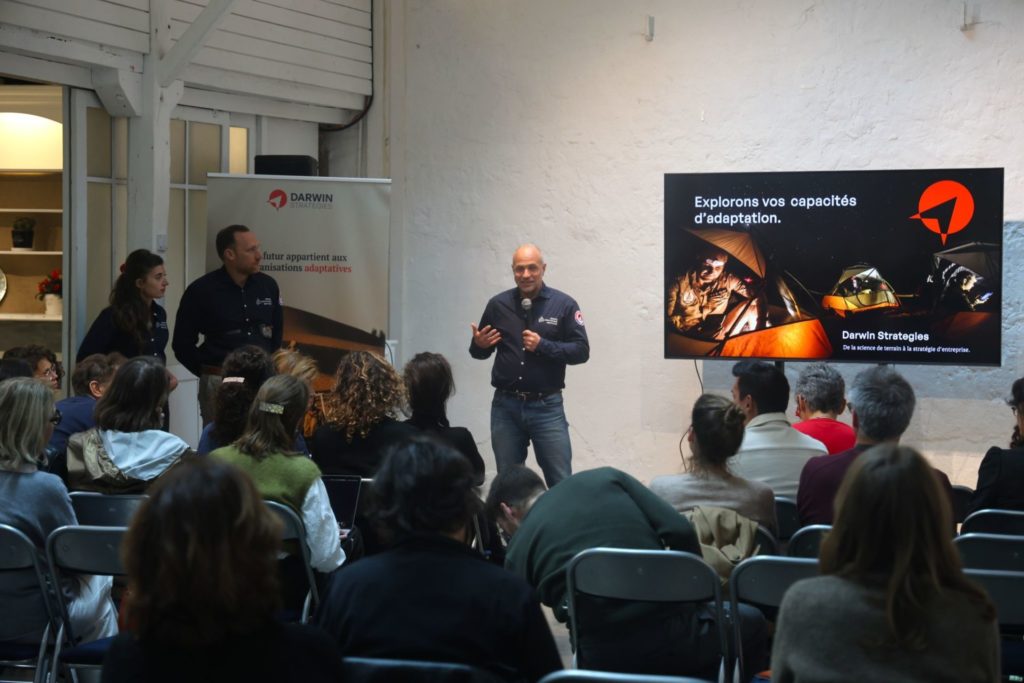
Last Tuesday, an afternoon and evening were dedicated to the launch of Darwin Strategies, a new branch of the Human Adaptation Institute, dedicated to supporting organisations in a world that has become permanently unstable, complex and changing.
Alongside its scientific work, the Human Adaptation Institute has been supporting companies, organisations and managers for several years in the face of the profound transformations that are shaking up their environments. Hundreds of conferences, immersive workshops and methods developed in the field and backed up by research have gradually shaped an approach focused on an issue that has become central: the ability of organisations and teams to adapt.
Darwin Strategies was born of this dynamic: the culmination of years of scientific research and field experiments carried out within the Institute, and the starting point for a new collective exploration. Backed by the Human Adaptation Institute, it joins an ecosystem committed to a habitable world, alongside the Adaptation Research Fund and Darwin Production.
Its ambition is clear: to provide organisations with a compass for navigating a world in polycrisis, to give them concrete tools for taking action, and to keep their sights on a habitable future for all living things.
To embody this vision, we needed a day to match the stakes.
Designed as a journey through extreme environments, it immersed participants in the realities that organisations now have to face: climatic crises, geopolitical instability, technological transformations and new human and organisational dynamics.
Throughout the afternoon, guests were immersed in the DNA of Darwin Strategies: the field. Where transformations take place in practice. Where people have to learn to make decisions, cooperate and adapt.
Two immersive workshops punctuated the day.
The first one, «What if 50°C?», with Alexandre Florentin and his team, placed participants in a climate crisis management exercise. It was an experiment designed to examine the ability of organisations to adapt to extreme events and their practical consequences on territories, activities and decision-making.
The second, «Faced with the impossible, lost in the storm», led by Christian Clot, explored the mechanisms of leadership, collective commitment and cooperation in hostile and uncertain contexts.
These workshops also provided an opportunity to present a number of analysis tools and methods developed by Darwin Strategies' teams, including sociometers, which enable the behavioural dynamics of a group to be observed, and Adascore®, dedicated to assessing the adaptability of teams and organisations.
In addition to the experiments, the day was an opportunity to present the various support formats developed by Darwin Strategies: conferences, immersive workshops, learning expeditions, programmes for directors and managers and customised support. All designed to help organisations transform uncertainty into a capacity for action.